
You’re safe here. Let’s help your body settle first.
You don’t need to figure anything out right now — just take this one small step at a time.
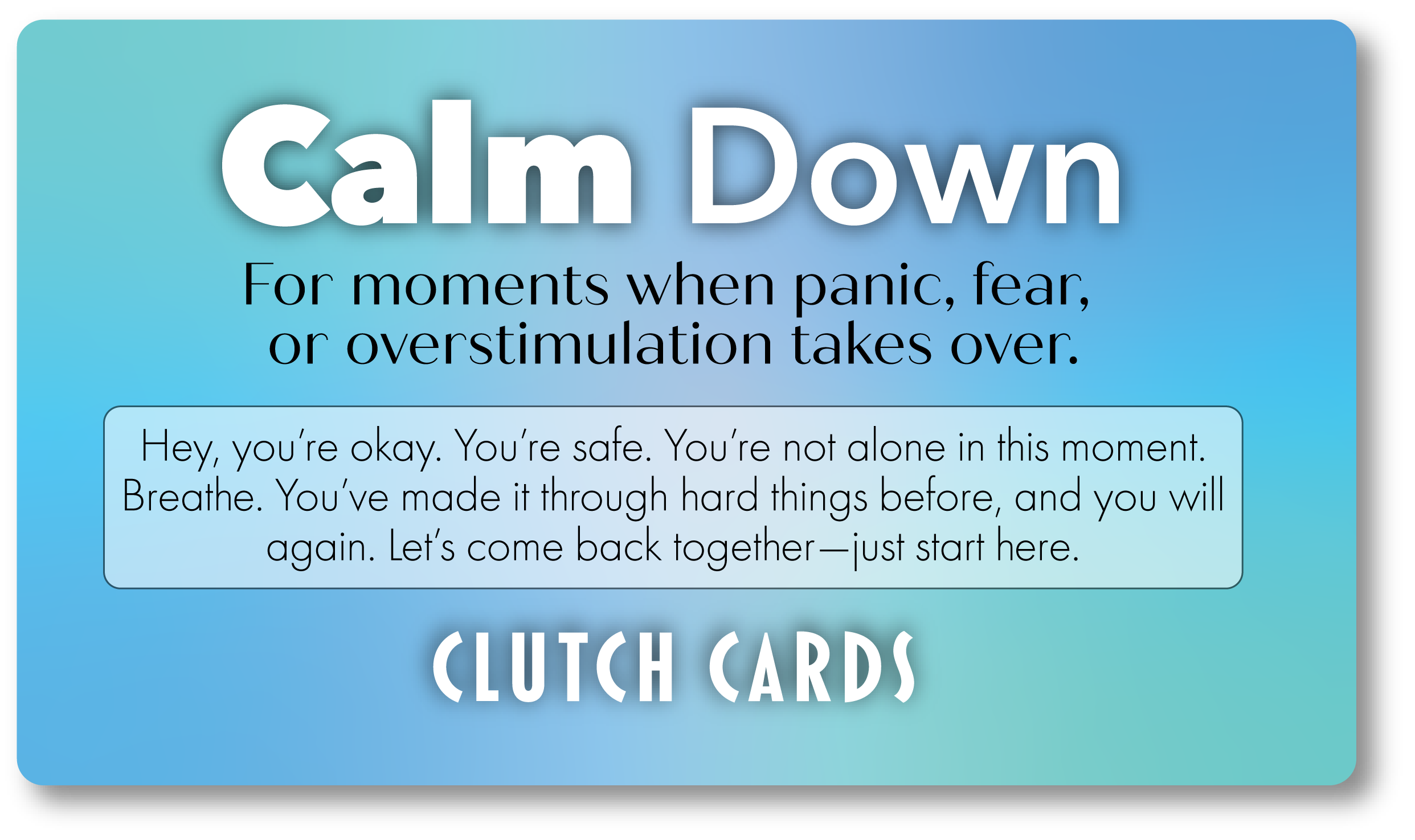

Start Here —
a 60-second reset for your body.
Give this step a moment. When you feel even a little relief, continue.
1. Belly Breath Reset (20 seconds)
Hand on your lower belly.
Inhale for 4… hold for 1… exhale for 6.
Let your exhale be a little longer than your inhale.
2. Temperature Shift (20 seconds)
Touch something cool or run cool water over your wrists.
This drops your heart rate and interrupts panic.
3. Feel Your Feet (20 seconds)
Notice the weight of your feet grounding you.
Feel the floor holding you up.

Pause here. Notice if anything feels even slightly softer.
You don’t need to rush this. You’re safe. What you’re feeling is valid — and it’s already shifting.

Step 1 — Relax your body around the feeling
Drop your shoulders. Unclench your jaw.
Let your stomach soften.
Step 2 — Notice exactly where the sensation lives
Is it tightness? Pressure? Heat? A swirl?
Is it in your chest? Throat? Solar plexus? Gut?
Step 3 — Stay with the sensation
Just notice it. No story. No judgment.
Let your awareness rest on the feeling itself.
Step 4 — Give it space
Imagine you’re creating a little room around the sensation. Let it be there without squeezing it or pushing it away.
Step 5 — Let it shift on its own
You may feel it soften, change shape, move, or dissolve.
That’s your awareness — not the thought — taking the lead again.
If the feeling is still sitting in your chest, throat, or stomach, let’s work with it instead of fighting it.
If you feel even a small shift, you’re ready to continue.
If not, stay here as long as you need — this step is powerful.
Understanding why this happened — in simple human terms.
Your nervous system sensed danger
Even if nothing was actually wrong, your body reacted protectively.
Your breathing changed before you noticed
Shallow breathing signals “danger,” and your brain responds accordingly.
Everything became louder
Your senses and thoughts sharpened to scan for threats.
This reaction isn’t your fault
Your body was overwhelmed — not broken, not dramatic.
Just overloaded.

Why these steps helped — and the science behind them.
Knowing what’s happening in your body can make the moment feel less scary — and help you trust that the calm you’re feeling is real.
Belly Breathing Reset:
Long exhales activate your parasympathetic (calming) system.
-
Activates your vagus nerve
The vagus nerve is like your body’s “calm switch.” When you take slow belly breaths, you gently turn that switch on, signaling your brain that you’re safe.Shifts your nervous system into parasympathetic mode
This is your rest-and-recover mode. When it's active, your heart rate slows, muscles unclench, and your mind becomes clearer.Reduces cortisol in minutes
Slow breathing can lower stress hormones faster than most other tools, making it one of the quickest ways to feel relief.
Temperature Shift
Cold activates your body’s calming reflex and interrupts panic.
-
Co-opts the ‘dive reflex’
Cold water on your wrists or holding something cold briefly triggers a built-in calming reflex that slows your heart rate.Interrupts the stress loop
When your brain receives a strong physical cue (like cold), it pulls focus away from the spiraling thought pattern.Releases adrenaline safely
The sudden cold helps the body process built-up stress chemicals instead of storing them.
Grounding
It anchors your senses back into the present moment.
-
Shifts your brain from threat mode to present mode
Your mind can’t fully spiral and fully observe the environment at the same time — grounding forces your awareness outward.Disrupts racing thoughts
It breaks the “mental looping” pattern by giving the brain a new task with immediate feedback.Rebuilds a feeling of safety
Your senses can only detect now — and “now” is usually safer than the story your thoughts were spinning.
You’re back in your body — now choose what feels right for you.
Giving yourself a choice is part of calming your system.
→ Learn more about what happened
Understand why your body reacted the way it did.
→ See recommended books & podcasts
Find voices, tools, and ideas that help you grow.
→ Join our community on Facebook
You’re not alone. Connect with others who get it.
→ Save this page for next time
A reminder that you can always come back here.
→ Go for a walk (10–30 minutes)
Movement helps complete the stress cycle and clears your head.
→ Do a workout (20–30 minutes)
Burns off leftover adrenaline and stabilizes the nervous system.
→ Try a yoga video on YouTube
Combines breath + movement to calm the body and steady emotions.
→ Call or text someone you trust
Connection co-regulates your nervous system — we calm faster together.
→ Step outside for fresh air
A change in sensory environment signals safety to your mind.
→ Listen to calming music or a guided meditation
Sound shifts brainwaves into calmer states.
→ Take a warm shower
Heat relaxes the body and engages the parasympathetic nervous system.
→ Journal for 5 minutes
Get what’s in your head out of your head. It reduces mental load immediately.
Whatever you choose is okay. Your pace is the right pace.
You came here to take care of yourself — that already shows your strength.
You can return to this calm anytime.
You’re safe in your body, and you’re coming back to yourself.