
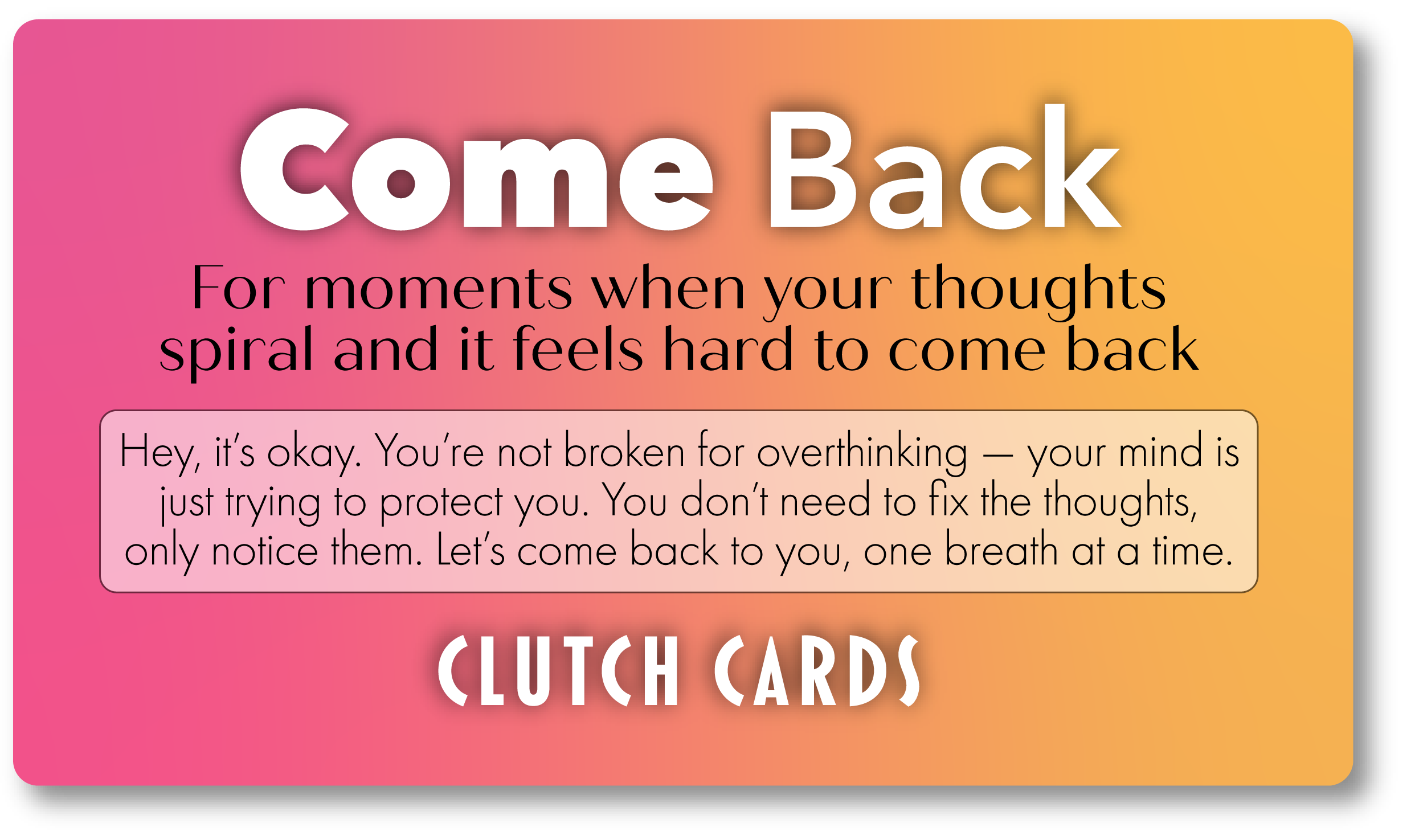
You’re safe here. Your thoughts are loud, but you don’t have to follow them.
You don’t have to sort anything out right now — just come back, one breath at a time.

Start Here —
a 60-second reset for your mind.
When you feel even a little more present, continue.
1. Anchor Breath (20 seconds)
Hand on your chest.
Inhale for 4… hold for 1… exhale for 4.
Match the inhale and exhale — this balances your mind and settles racing thoughts.
2. Name One Thing You See (20 seconds)
Gently look around the room.
Pick one object and describe it in your mind — shape, color, texture.
This interrupts looping thoughts by giving your brain a simple, concrete task.
3. Feel a Physical Contact Point (20 seconds)
Place your palm on your leg, your arm, or the surface you’re sitting on.
Feel the pressure and temperature.
Let your awareness rest there — it brings your mind back into your body.
These three practices are the scientific “fast exits” from mental spiraling:
➡ balanced breath calms cognitive overload
➡ visual focus breaks looping
➡ physical contact reorients the mind to the present moment

PAUSE HERE. NOTICE ANY SMALL SIGN THAT YOU’RE HERE AGAIN.
A deeper breath… a sound you can hear… a sensation in your hands —
anything that tells you you’re reconnecting. You’re doing exactly what you need to.

Step 1 — Soften around the feeling
Drop your shoulders. Unclench your jaw.
Let your belly loosen.
You’re telling your body, “We’re safe enough to let go.”
Step 2 — Notice exactly where the sensation lives
Is it fluttery? Tight? Hollow? Numb?
Chest? Throat? Solar plexus? Belly?
You’re just locating it — nothing more.
Step 3 — Stay with the sensation
Simply observe it.
No meaning. No story. No self-blame.
Just: “This is what’s here.”
Step 4 — Give it space
Imagine a little room opening around the feeling.
You’re not trying to shrink it or push it away —
You’re letting it breathe.
Step 5 — Let it fade on its own
It might soften… shift… warm… move… or ease slightly.
This is your awareness leading — not the thought, not the spiral.
If your mind still feels far away or your body feels off, let’s work with the sensation instead of resisting it.
If you feel even a subtle shift — a little more here, a little more present — you’re ready to continue.
If not, stay with this step. This is the part that brings you back.

Understanding why this happened — in simple human terms.
Your mind wasn’t “out of control.” It was overwhelmed.
When your thoughts race or loop, your brain is trying to solve something it believes is urgent — even if nothing immediate is wrong.
Your nervous system shifted into protection mode.
Instead of physical danger, the trigger was internal:
a worry, memory, fear, or imagined scenario.
Your brain treats emotional threats just like physical ones.
Your breathing changed before you noticed.
Racing thoughts often come after your breath becomes shallow.
Shallow breathing signals danger, which makes your mind sharpen and speed up.
Your attention narrowed.
Your brain filtered out everything except the perceived “problem.”
This makes the world feel smaller, tighter, and louder.
This response isn’t a flaw.
You’re not broken, dramatic, or “too much.”
Your brain hit overload — and did exactly what human brains are wired to do.
And now you’re coming back.
Every breath you take, every pause you create, shifts your system back toward clarity and presence.
Why these steps helped — and the science behind them.
Understanding what’s happening in your mind and body takes the fear out of the moment — and helps you trust that the clarity you’re feeling now is real, not temporary.
MICRO-EXHALE RESET:
A longer exhale quiets your nervous system and signals that you’re safe.
-
Extending your exhale activates the parasympathetic “rest and settle” system
Diaphragmatic movement stimulates the vagus nerve, lowering arousal
Reduces amygdala reactivity (the part of the brain that scans for danger)
Helps regulate CO₂ balance, which reduces panic sensations
Tells your brain: “We’re safe enough to shift out of survival mode.”
ORIENTATION GLANCE:
Looking around the room tells your brain you’re not in danger anymore.
-
The “orienting response” signals to the nervous system that the environment is safe
Eye movements help deactivate the threat-scanning loop in the amygdala
Visual cues pull attention from internal alarm sensations back into the present
Breaks dissociation, tunnel vision, and spiraling thought loops
Tells your brain: “Nothing is attacking us. We can settle.”
GENTLE NAMING:
Putting words to what you feel softens the intensity and restores clarity.
-
Affect labeling reduces activation in the amygdala (emotional alarm center)
Increases prefrontal cortex activity (the part responsible for logic and calm)
Creates psychological distance from thoughts (“observer mode”)
Turns an overwhelming sensation into something understandable and workable
Tells your brain: “This is a feeling — not a threat.”
You’re back in your body — now choose what feels right for you.
Giving yourself a choice is part of calming your system.
→ Learn more about what happened
Understand why your body reacted the way it did.
→ See recommended books & podcasts
Find voices, tools, and ideas that help you grow.
→ Join our community on Facebook
You’re not alone. Connect with others who get it.
→ Save this page for next time
A reminder that you can always come back here.
→ Use the “Next Best Thought” practice
Choose a thought that’s just slightly better than the current one.
Not positive — just less painful.
This is a CBT-backed micro-shift technique that breaks catastrophic spirals.
→ Do a brain-dump reset (2–3 minutes)
Set a timer, write down EVERYTHING that’s buzzing around in your mind — messy, fast, uncensored.
This unloads working memory and reduces cognitive overwhelm.
→ Go for a walk (10–30 minutes)
Movement helps complete the stress cycle and clears your head.
→ Do a workout (20–30 minutes)
Burns off leftover adrenaline and stabilizes the nervous system.
→ Try a yoga video on YouTube
Combines breath + movement to calm the body and steady emotions.
→ Call or text someone you trust
Connection co-regulates your nervous system — we calm faster together.
→ Step outside for fresh air
A change in sensory environment signals safety to your mind.
→ Listen to calming music or a guided meditation
Sound shifts brainwaves into calmer states.
→ Take a warm shower
Heat relaxes the body and engages the parasympathetic nervous system.
→ Journal for 5 minutes
Get what’s in your head out of your head. It reduces mental load immediately.
Whatever you choose is okay. Your pace is the right pace.
You showed up for yourself today — that’s powerful.
Your body remembers how to settle, and so do you.
You’re safe here. And you can return to this feeling whenever you choose.