
When emotions run hot, cooling down shouldn’t feel impossible.
Everyone deserves to feel safe and steady inside themselves — even in moments of intensity.
What you’re feeling is valid. Anger isn’t wrong — it’s protective.
Right now, let’s help your body cool off so your clarity can return.
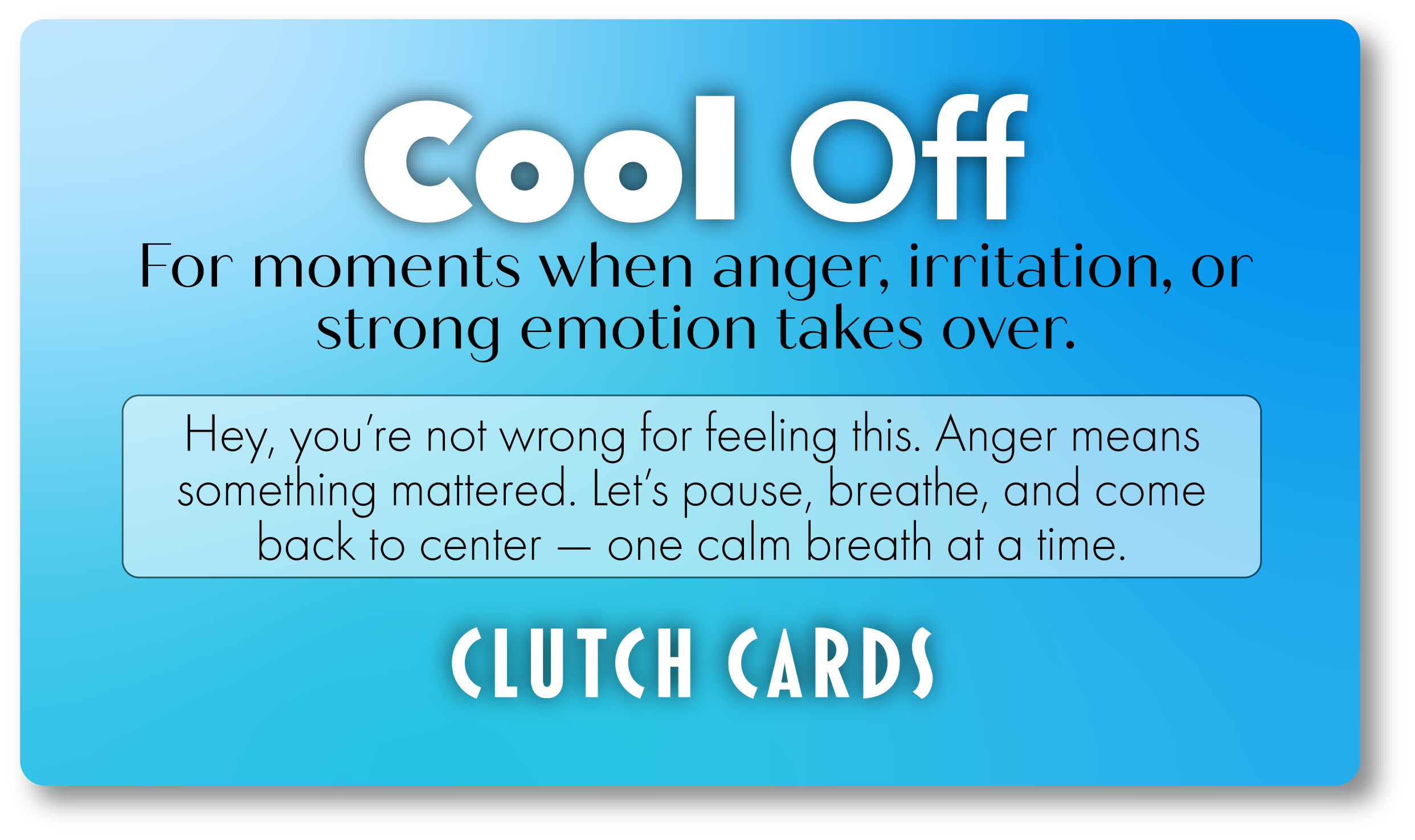

Start Here — a 60-second reset to cool your system.
Give this step a moment. When you feel even a little less hot, continue.
1. Step Away
Leave the room or take 5–10 steps away from the trigger.
Distance drops emotional intensity by nearly 50% in under two minutes.
This gives your nervous system the interruption it needs.
2. Temperature Drop (30 seconds)
Hold something cold or run cool water over your wrists.
Anger cools when your skin cools.
This lowers your heart rate and softens the heat instantly.
3. Shake Out Your Body (30 seconds)
Loosen your hands, arms, and shoulders.
Shake out the tension like you’re shaking water off your hands. Do jumping jacks, jump up and down, or any other movement that works to release this built-up energy.
This releases adrenaline and stops the “ready to explode” pattern.

Hold here for a second. Feel if the pressure has eased, even slightly.
You’re okay. Your body is backing off from the surge — you don’t have to force anything.
Step 1 — Find the sensation, not the story
Where is the leftover intensity sitting?
Chest? Throat? Jaw? Hands? Belly?
Just name it quietly:
“Heat.”
“Tightness.”
“Pressure.”
“Buzzing.”
Step 2 — Observe it with soft curiosity
Instead of trying to change it, notice it the way you’d watch a wave rise and fall.
You’re not judging it.
You’re not fueling it.
You’re just watching.
This lowers the amygdala’s threat response.
Step 3 — Let your body soften around the sensation
Drop your shoulders.
Unclench your jaw.
Let your stomach untighten even a little.
This tells your nervous system,
“This feeling is safe to experience.”
Step 4 — Give the sensation space
Imagine the feeling has room to move.
Not trapped. Not squeezed.
Just space.
Most people feel the intensity change here —
It may soften, shift, or move.
Step 5 — Let it unwind on its own
No forcing.
No fixing.
Just letting the body complete what the spike started.
This is what dissolves anger at the root.
After the spike — work with what’s left in your body
You’ve cooled the surge.
Now let’s help your body release the leftover tension without feeding the anger again.

Stay here as long as you need — this step is powerful.
Understanding why this happened — in simple human terms.
Your anger didn’t come out of nowhere.
Something in your body or environment signaled “not okay,” and your nervous system reacted fast — often before you had time to think.
Your body registered a threat — real or perceived
Anger is the nervous system’s protection mode.
It shows up when something feels unfair, overwhelming, disrespectful, or out of control.
Even if the danger wasn’t physical, your system treated it like it was.
Your brain went into “act now” mode
When anger hits, your amygdala floods your body with adrenaline.
Muscles tense, heart rate spikes, breathing gets shallow.
Your brain prepares you to do something — fast.
Your thinking brain went offline for a moment
This isn’t weakness.
It’s biology.
During an anger spike, the prefrontal cortex (logic, reasoning, perspective) temporarily powers down so your survival system can take over.
This is why everything can feel louder, bigger, and hotter than the situation actually is.
Your body tried to protect you — just a little too intensely
Anger is a sign that something mattered to you.
Something felt wrong, unsafe, crossed, or violated.
Your system overreacted because it was trying to defend you.
Nothing about this reaction makes you broken
You weren’t “being dramatic.”
Your nervous system just hit the gas too hard, too fast.
And now that you’re here — cooling down, breathing, choosing differently — you’re showing the strength your nervous system didn’t have in the moment.
You’re already coming back into yourself.

Why these steps helped — and the science behind them.
Knowing what your body is doing — and why it responds the way it does — can make anger feel less explosive and more manageable.
It also helps you trust that the calm you’re starting to feel is real, not temporary.
Cooling your skin:
When you cool your wrists, palms, or face, your body triggers the mammalian dive reflex — a natural “calm switch” that slows your heart rate and drops emotional heat almost instantly.
-
Cold activates receptors that engage the vagus nerve, which signals the parasympathetic (calming) system. This turns down your fight-or-flight response and helps your body exit the anger spike.
sitting w/ sensation:
Turning toward the physical feeling — instead of the story — helps the emotion move through you instead of building pressure.
-
Interoceptive awareness activates brain regions that regulate emotion and soften the amygdala’s response, helping the feeling unwind instead of escalate.
move your body:
Shaking your hands, arms, or shoulders releases the adrenaline and tension anger creates.
It gives your body an outlet so the energy doesn’t build and explode.
-
Anger increases cortisol, adrenaline, and muscle contraction. Physical movement metabolizes these chemicals faster and sends calming feedback from your muscles to your brain through proprioceptive input.
leaving the room:
Physically stepping away from what’s triggering you immediately reduces emotional intensity.
Distance tells your nervous system that the threat is no longer right in front of you.
-
When you stay near the trigger, your amygdala keeps firing. Changing your environment breaks that loop, letting your prefrontal cortex (logic, perspective) come back online as the intensity falls.

You’ve cooled off enough to choose your next step.
Choice is how you stay in control now — not the emotion.
Giving yourself a choice is part of calming your system.
→ Learn more about what happened
Understand why your body reacted the way it did.
→ See recommended books & podcasts
Find voices, tools, and ideas that help you grow.
→ Join our community on Facebook
You’re not alone. Connect with others who get it.
→ Save this page for next time
A reminder that you can always come back here.
→ Go for a brisk walk (10–20 minutes)
Anger needs movement. Walking burns off the leftover adrenaline that’s still flooding your system and helps your brain shift out of “attack-mode.”
→ Do something physical (20–30 minutes)
A workout, shadow-boxing, heavy-bag hits, running, swimming — anything that safely uses the energy that anger generated. Physical exertion restores regulation faster than anything else.
→ Step outside for air + space
Heat, walls, noise, and proximity make anger worse. Fresh air and open space signal safety to the brain and help the emotional temperature drop.
→ Call or text someone who grounds you
Not to vent — but to regulate. Human connection calms the nervous system because our bodies sync to steadier people.
→ Shift your environment
Go to a different room. Sit in your car. Walk to the mailbox. Changing the sensory input breaks the mental loop that keeps anger hot.
→ Take a warm shower
Heat relaxes the muscles that clench when you’re angry and reduces cortisol. It’s one of the fastest ways to drop tension out of the body.
→ Use sound to reset
Calming music, low-frequency tones, or a guided meditation can interrupt rumination and shift your brainwaves into a calmer rhythm.
→ Journal for 5 minutes
Dump the mental chaos onto paper. Even one paragraph helps your brain process the trigger without escalating the emotion.
Whatever you choose is okay. Your pace is the right pace.
This is how change happens
You came here — even in the heat of it — and that takes real strength.
This moment is the work. Keep choosing this, and everything starts to shift.
Come back here as often as you need. You’re learning a new way to move through anger, and it’s already happening.